
 Image 1 of 1
These limited edition fine art prints are signed and numbered on acid free rag paper using archival inks rated to resist fading for 100 years under recommended display conditions.
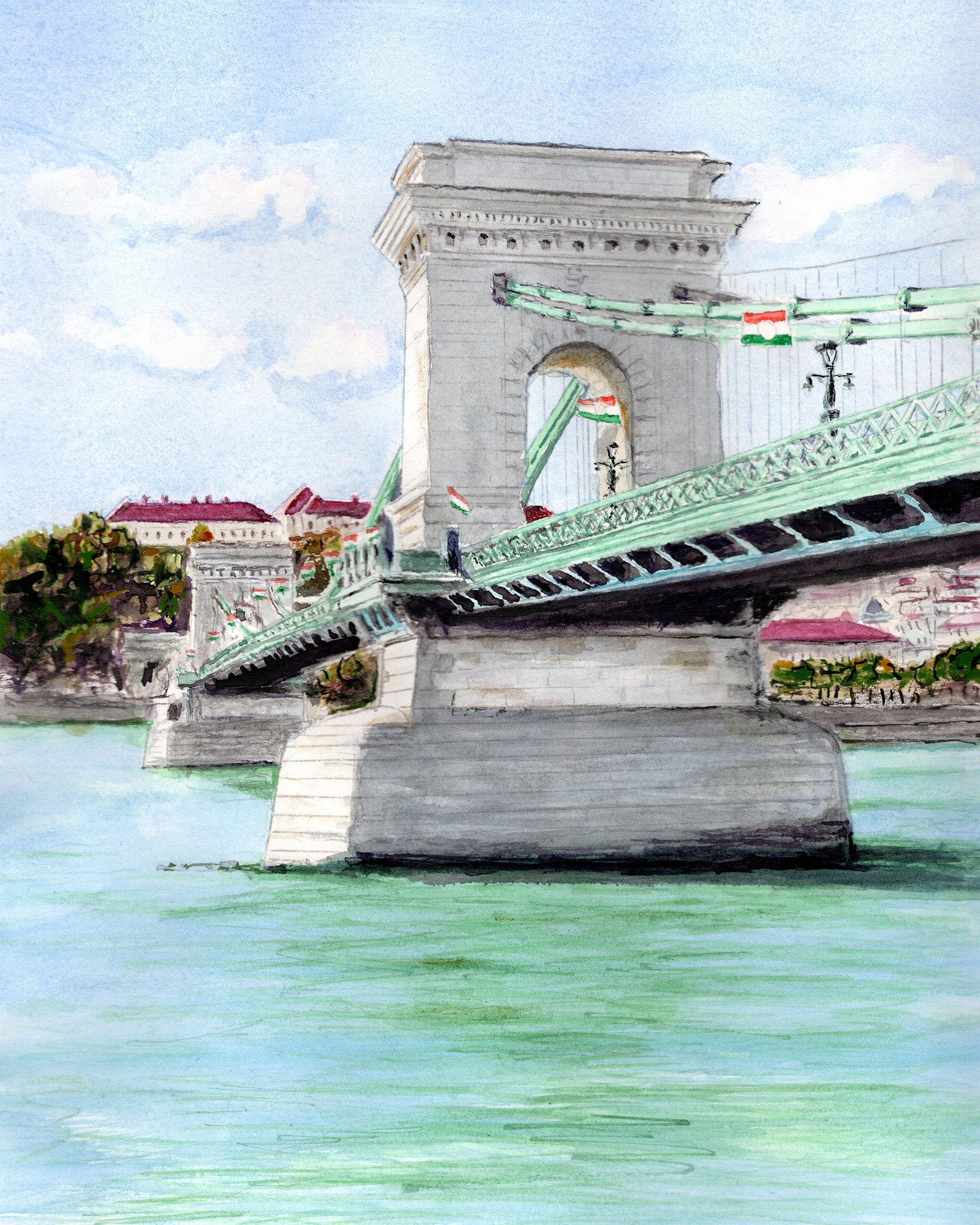
This watercolor painting depicts the Chain Bridge in Budapest, Hungary. The Chain Bridge, or Széchenyi Lánchíd, is the oldest permanent bridge in Budapest, connecting the Buda and Pest sides of the city. Opened in 1849, it is a significant symbol of national pride and engineering. The bridge’s cast-iron structure was updated and strengthened in 1914. In World War II, the bridge was blown up on 18 January 1945 by the retreating Germans during the Siege of Budapest, with only the towers remaining. It was rebuilt, and reopened in 1949.
The bridge is decorated with flags for Hungarian Independence day, October 23rd. There is a circle cut from the center of each flag where the hammer and sickle was displayed. This represents Hungary’s independence from the Soviet Union as an occupying force from 1949 until 1989.